



source:Industry News
release time:2022-11-15
Hits:0
Popular:
In recent years, the development of clean energy has become the consensus of most countries in the world. our country has even put forward the grand goal of "carbon peaking and carbon neutrality". Clean energy power generation technologies such as solar energy, wind energy and tidal energy which has the characteristics of intermittent, random, and strong geographical dependence have been developed rapidly. In order to solve the time and space limitations of new energy power generation and improve the utilization rate of new energy, the importance of energy storage technology has become prominent increasingly. According to the conversion and storage methods of electrical energy, energy storage technologies are divided into physical energy storage, chemical energy storage and electrochemical energy storage. electrochemical energy storage which has the characteristics of high energy conversion efficiency and fast response speed,lt includes secondary battery technology and supercapacitors,.the secondary battery technology also has the advantages of high energy density and easy modularization Especially.
In the secondary battery market, lithium-ion batteries are the absolute main force and core. Although lithium-ion batteries are free of obvious performance limitations relatively, sourcing raw materials such as lithium carbonate and lithium cobaltate is becoming difficult increasingly. As battery pack sizes and installed numbers increase, lithium resources are difficult to meet demand. Therefore, it is necessary to carry out research work on the replacement of lithium-ion batteries whic can overcome the excessive dependence on scarce lithium resources.
Fortunately, research on Na-ion batteries has grown extensively over the past decade due to concerns of lithium supply shortages and the need for alternative, sustainable battery technologies.Although lithium compounds exhibit excellent electrochemical properties, the wide distribution and low cost of sodium resources compared to lithium are expected to change the fortunes of the lithium-ion battery company.
Na-ion battery battery principle:
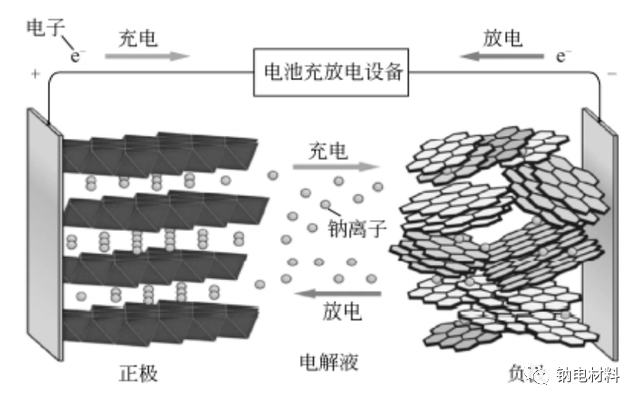
The working principle of Na-ion batteries is the same as lithium-ion batteries, under a certain potential condition, the reversible extraction and insertion of guest alkali metal ions in the host material where the higher intercalation potential acts as the positive electrode, and the lower intercalation potential acts as the positive electrode. The negative electrode, the charging and discharging cycle of the whole battery is the round-trip directional migration process of alkali metal ions which between the positive and negative electrodes. The battery with working mechanism is called "rocking chair battery". The composition and structure of sodium ion batteries are the same as those of lithium ions exactly, they are positive electrodes, negative electrodes, electrolytes, separators and current collectors. According to the material if participates in the electrochemical reaction process directly , they can be divided into active materials and inactive materials.
Na-ion battery development:
Throug the development history of Na-ion batteries, the research process of Na-ion batteries can be divided into two stages which are inseparable from the research of lithium-ion batteries.we start from these two stages to talk about the "past and present" of Na-ion batteries.
Research on Na-ion batteries can be traced back to 1970s, starting at the same time as research on lithium-ion batteries. In the early research, lithium-ion batteries and Na-ion batteries had a similar research history. The reversible electrochemical intercalation reaction of layered TiS2 with lithium in Li//TiS2 batteries which reported by Whittingham in 1976. They found that sodium and lithium can be intercalated into TiS2 and other transition metal dichalcogenides. Due to the low open-circuit voltage (about 2.2 V) of the TiS2 cathode and the instability which caused by the metallic lithium anode, Li//TiS2 batteries cannot be developed into functional batteries with commercial prospects which caused first major setback of Li/Na-ion battery R&D.
In order to solve the disadvantage of low cathode voltage, Goodenough used layered metal oxides as battery cathodes in the 1980s. Its chemical composition is LiMeO2 for Li-ion batteries and NaMeO2 for Na-ion batteries (Me stands for Co, Ni, Cr, Mn or Fe). In terms of battery voltage, the discovery is groundbreaking. For example, the open circuit voltage of LiCoO2 is 4.0 V which is almost twice of TiS2. We can say, the electrochemical performance of lithium-based compounds is better than sodium-based compounds.
However, the anode of choice for Li/Na-ion batteries with new cathode materials is still metallic lithium or sodium. These active metal anodes can react with the electrolyte which causes the battery to become unstable. In addition, during the intercalation and deintercalation cycles, the dendrites of the metal anode would grow uncontrollably which is the main cause of internal short circuits and fires in the battery. Metal anodes are not a good choice for safety reasons. As an alternative, Scrosati suggested a low-voltage intercalation anode to replace the metal anode which marked the birth of the "rocking chair" battery. The rocking-chair battery which replaced lithium metal with an intercalation acts as both poles. In this way, there is space on both sides for lithium ions to intercalate. During the charge-discharge cycle, lithium ions are intercalated and deintercalated back between the positive and negative electrodes, Unfortunately, in the case of sodium ions, since the radius of sodium ions is larger than lithium ions, it is difficult for sodium ions to intercalate and de-intercalate in soft carbon which became a second setback for the commercial prospects of Na-ion batteries.
Although the research of sodium ion batteries is stagnant, high temperature sodium ion batteries have been developed deeply. a sodium-sulfur battery system operating between 300 and 350°C was developed by Tokyo Electric Power Company and Japan's NGK Corporation.lt is called sodium-nickel chloride battery. At same time ,Zebra batteries which operates between 250 and 300°C and were developed by Zeolite Battery Research originally. A common feature of these battery systems is the use of molten sodium anodes and ceramic separators. They are Appllyed to electric vehicles,space.but, the high operating temperature brings other problems, such as corrosion problems, safety problems and low energy efficiency
In 2000, Stevens and Dahn found that a good intercalation properties of sodium ions in hard carbon materials which Aroused interest in room-temperature Na-ion batteries. The hard carbon anode in Na-ion batteries has a low voltage and a high-quality capacity of 300 mAhg-1 which is close to graphite (372 mAhg-1) in Li-ion batteries. Although the discovery proved to be a turning point in Na-ion batteries, But it did not spark a rush of commercial research immediately because of there having been a clear lack of demand which could replace lithium-ion batteries at the time. The patent-based analysis shows that the surge in patent filings of Na-ion batteries started in 2012, It can be found that the driving force for Na-ion batteries to replace lithium-ion batteries which is the supply shortage of the large-scale application in ithium-ion batteries. Since 2010, unprecedented progress has been made in the research of cathode materials for Na-ion batteries. The total number of cathode materials reported is almost equal to the total number that existed before between 2010 and 2013. The three main types of cathode materials for Na-ion batteries are layered metal oxides, polyanionic compounds, and Prussian blue-like compounds. The goal of material selection is to create an inexpensive Na-ion battery, This explains the selection of earth-abundant elements, such as iron, manganese and magnesium, as far as possible in the composition of the cathode material
In 2015, the French Research Network (RS2E) established by the French National Centre for Scientific Research (CNRS), the French Alternative Energies and Atomic Energy Commission (CEA) and the Collège de France collaborated to develop the first "18650" cylinders which is called Na-ion battery. This is the beginning and a huge leap forward in the commercialization of room-temperature Na-ion batteries. Led by these start-ups, more than a dozen companies have emerged to develop Na-ion batteries. In April 2019, the largest Na-ion battery module with a power of 100KW was producted.
future development:
"Carbon neutrality" has spawned a terawatt-hour battery demand, new application scenarios are emerging constantly and new technologies have been more used widely. Diversified technical routes will be the main theme of the battery industry in the future.by the east wind of carbon neutrality and carbon peak, sodium ion has full market competitiveness with the advantage of sufficient energy storage in the future.
Read recommendations:
solar power battery storage Processing
Marine Boat 12V 24V 36V Deep Cycle RV Lithium LiFePo4 Battery for Trolling Motor
Optimizing Motorcycle Performance: The Advantages of Deltran Lithium Batteries and Chargers
UAV intelligent battery knowledge popularization

Last article:Important factors affecting internal resistance of battery
Next article:Voltage and capacity of lithium battery
related suggestion
lithium batteries for solar panels sales
2023-03-20deep cycle trolling motor battery wholesaler
2023-04-0712 volt deep cycle batteries
2023-04-07deep cycle marine battery wholesaler
2023-03-20lithium trolling motor battery Factory
2023-03-20deep cycle marine battery Processor
2023-03-20portable solar generator
2023-05-08best marine battery
2023-05-0848 volt golf cart batteries
2023-05-08solar generator amazon
2023-05-08lithium trolling motor battery
2023-05-08portable battery generators
2023-05-08Customizable LiFePo4 Battery for AGV Robot 60V 72V
2023-02-0932700 3.2V Special Battery Cell Rechargeable Explosion Proof
2025-04-11HB-N300 300W Solar Power Station Black
2022-09-09Hysincere 500W Portable Power Station Solar Powered
2022-09-09Forklift Battery 12V 150Ah
2022-09-19How to Plan a Wonderful Camping Trip: 6 Simple Steps
2022-09-07The Future of Energy Storage: Key Trends and Market Insights for Businesses
2025-03-13The working principle of iron lithium batteries.solar generator amazon
2023-07-20Why Solid State Home Batteries Are the Future of Residential Energy Backup
2025-05-23Choosing the Best 18650 Flashlight Batteries for Professional and Industrial Use
2025-09-28Polymer lithium battery customization
2023-02-03lithium polymer battery.best batteries for off grid solar
2023-05-23Portable UPS energy storage power supply application field
2023-02-11Methods to judge the battery
2022-11-17What are the advantages and disadvantages of soft pack lithium batteries?solar generators for sale
2023-08-23 info@hysincere.com
 Sales manager: Mr.Liu
 Contact number: +86 134 1879 9682
 Headquarter: Room 611, Building D, Bantian International Center, No.5 Huancheng South Road, Bantian Street, Longgang District, Shenzhen, China
China Factory: No.2 Building, Yihengda Technology Industrial Park, Long Jiang 2nd Road, Qingxi Town, Dongguan, China
Vietnam Factory: 4th Floor, Chelsea Residences Tower, No.48 Tran Kim Xuyen,Cau Giay District, Ha Noi City, Vietnam









 中
中
